Sharjah offers affordable housing, family-friendly communities, and strong investment potential. Learn about the best areas, property types, and lifestyle benefits in our complete Sharjah area guide.
.webp)
Sharjah is one of the most family-friendly emirates in the United Arab Emirates and a popular choice for those who want affordable housing while staying close to Dubai. It is famous for its cultural beauty, growing property market, and well-planned communities.
Sharjah offers apartments, villas, townhouses, and waterfront homes. If you're looking to buy, rent, or invest in the UAE. This emirate provides a wide range of options supported by good international schools, advanced healthcare facilities, shopping malls, and well-planned transport links all over the UAE.
Sharjah is one of the UAE's most popular places to live, especially for families and professionals who want more space and affordable property while staying close to Dubai.
On its western edge, Sharjah shares a continuous urban border with Dubai. The communities of Al Nahda, Al Majaz, Al Taawun, Al Mamzar, and Al Qasimia sit right at that interface. Al Nahda is located exactly on the Dubai-Sharjah border, neighbouring Al Taawun, Sharjah Industrial Area 3, Al Nahda Dubai, and Al Qusais Industrial Area 3.
This seamless urban continuity means Sharjah residents effectively have direct access to both emirate economies without leaving a single contiguous urban environment, which is something worth thinking about for both renters and investors.

The north side of Sharjah shares borders with Ajman and Umm Al Quwain. The east connects with Fujairah and Ras Al Khaimah. With six free zones, 33 industrial areas, and access to ports and airports on both coasts, Sharjah serves as an important gateway to the GCC.
Sharjah's economy is not heavily dependent on oil. Instead, it is supported by other sectors such as trade, manufacturing, tourism, and education, which help keep the property market strong.
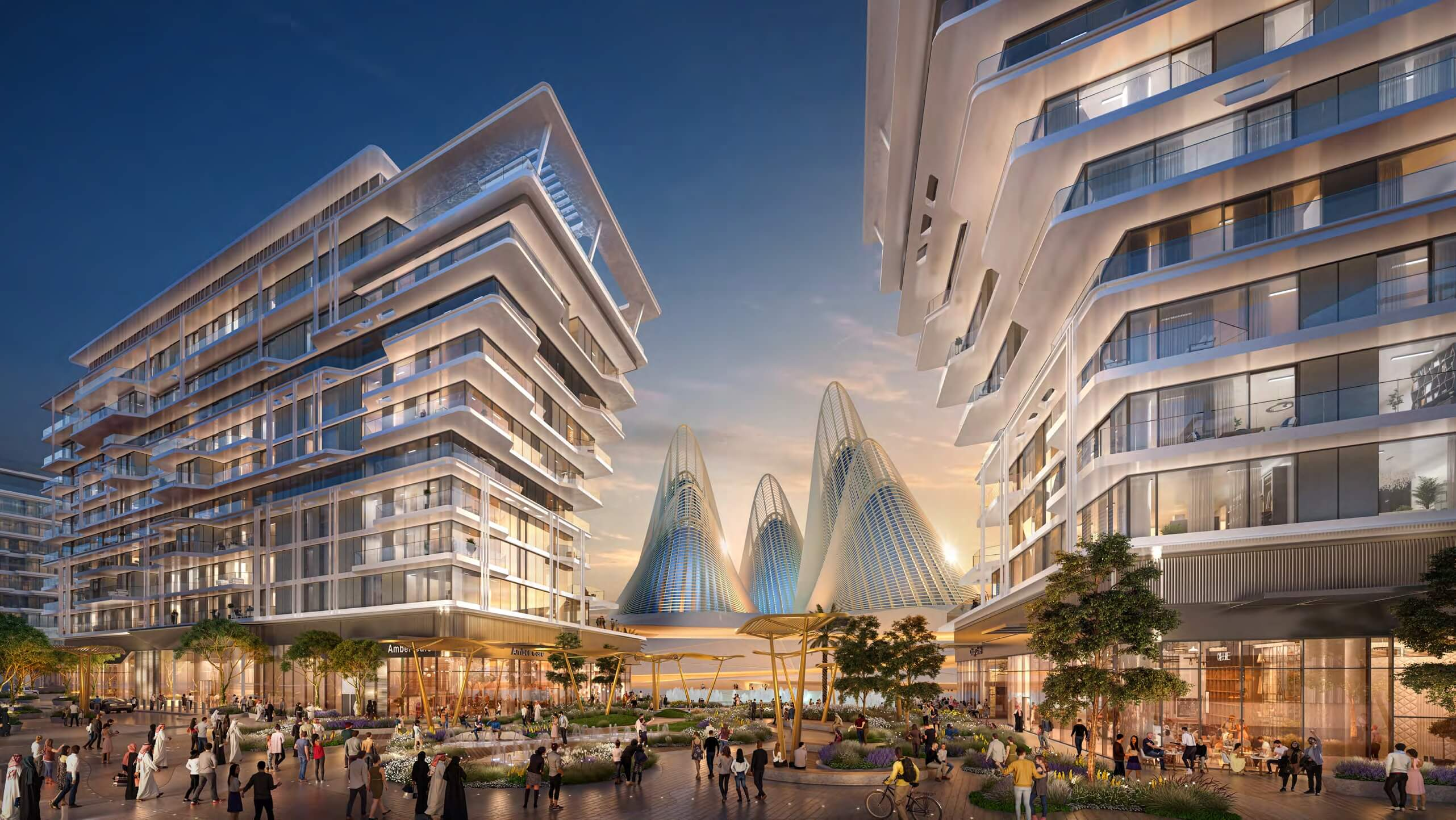
Developed by Arada, Aljada is Sharjah's largest urban development in the central-eastern part of the emirate. It has residential neighborhoods, commercial zones, and educational institutions, and Madar, the entertainment point designed by Zaha Hadid Architects, gives the community a distinct architectural identity.
Property values in Aljada have generally trended upward in recent years, supported by strong demand, ongoing development, and expanding community amenities.
Multiple handovers are scheduled, and the community continues to grow. It is one of the more actively transacted communities in Sharjah.
A premium master-planned gated community, Al Zahia offers villas and townhouses in landscaped clusters with playgrounds, parks, walking trails, and a community center.
Easy access to the Sharjah–Dubai highway makes it practical for families who commute. It is quiet, secure, and tends to attract mid- to upper-budget family buyers rather than short-term investors.
Located on Emirates Road, Tilal City is designed as a self-sustained smart city with mixed-use zones, educational institutions, and green spaces.
Since the community is still largely under development, many investors are purchasing residential plots to build their own homes, a relatively uncommon option in the UAE.
Tilal City offers foreigners a 100-year leasehold, and GCC nationals can buy freehold. It borders areas with strong transport links toward Muwaileh, Commercial Sharjah, and the University City corridor.
Muwaileh Commercial Sharjah is arguably Sharjah's most consistently occupied residential zone, built around its function as an education hub.
The properties here range from studios to three-bedroom apartments and three-to-five-bedroom villas and townhouses. It sits approximately 25 minutes from the Dubai border communities of Al Qusais and Al Nahda, connected by direct RTA bus routes and the E315 intercity service.
These are Sharjah's waterfront and urban-luxury addresses, positioned along the Khalid Lagoon and adjacent to the Al Majaz Waterfront, near the Sharjah Corniche and the broader Al Majaz district.

They attract residents who want a city-centre lifestyle, lagoon views, and proximity to cultural landmarks. Maryam Island, in particular, has been positioned as a premium branded address with waterfront apartments.
The first fully pedestrianized district in Sharjah, Al Mamsha, offers apartments surrounded by landscaped walkways and recreational areas.
The concept is relatively straightforward, with apartments with greenery and walkability, but it fills a gap in Sharjah's residential offering for residents who don't necessarily want or need a car-first environment.
Masaar is a forest community with over 50,000 trees, designed around a natural environment for living. Sendian villas and townhouses sit within a landscape that borders Sharjah National Park.
It is near Tilal City and University City and suits residents prioritizing greenery, outdoor lifestyle, and a degree of separation from the denser urban core.
Some of Sharjah's newer British and American school openings are also in this corridor, which is relevant for families considering the Suyoh and Al Rahmaniya suburbs.
The numbers coming out of Sharjah's property market in recent years are significant enough to mention plainly. Sharjah recorded AED 44.3 billion in real estate transactions during the first nine months of 2025.
The emirate's growing appeal stems from sustained government investment, improved transparency through the Aqari digital platform, and competitive freehold opportunities near the Dubai border.
None of this means the market is without risk. But unlike some high-growth markets where volatility can pose real problems, Sharjah has maintained a notably steady performance trajectory.
Sharjah's residential stock covers a wide range, wider than people outside the UAE might expect:
Studio Apartment
Studios and apartments are available in towers across older urban districts like Al Qasimia Sharjah, Abu Shagara Sharjah, and Al Majaz 1 Sharjah, as well as in newer master-planned communities.
Townhouses
Townhouses, generally with three to four bedrooms, are often found in communities like Al Zahia, Aljada, and Masaar.
Villas
Standalone villas range from modest three-bedroom family homes to larger five-bedroom configurations with private pools, particularly in Al Suyoh, Masaar, and the gated clusters of Al Zahia.
Luxury Apartments
Branded and serviced residences are a growing segment, with several developers introducing hotel-branded residential towers near Maryam Island and the Al Khan waterfront.
Commercial properties
Residential land plots available in areas like Tilal City are where investors can purchase plots and build custom homes, a relatively rare option in the broader UAE market.
Off-plan properties
Off-plan properties purchased before completion are common in Aljada, Masaar, Tilal City, and Sendian, and flexible payment plans are standard in this area.
Luxury Commercial Properties
Commercial real estate is available to foreign investors in designated zones and is concentrated in Sharjah's 33 industrial zones, including Industrial Area 6 Sharjah, and Sharjah Industrial Area 6.

Sharjah's foreign ownership laws have been repositioned since 2022. Through Law No. (2) of 2022, which was put forward by His Highness Dr. Sheikh Sultan bin Muhammad Al Qasimi, the emirate designated zones for international investors. It is a change from the previous position, which had restricted ownership to UAE and GCC nationals.
As of mid-2025, foreigners can secure property rights in Sharjah through two main mechanisms: full freehold ownership in designated zones, or life interest agreements elsewhere, meaning the right to use and benefit from a property for up to 100 years.
No UAE residency is required to purchase property as a foreigner. Registration fees are approximately 2% for right-of-use registrations and up to 4% for freehold purchases.
The Sharjah Real Estate Registration Department (SRERD) oversees the registration process, which has become more transparent in recent years. Many investors work with licensed real estate advisors such as AQARY Investment and Development to help guide them through the process.
Sharjah has built one of the UAE's more comprehensive educational ecosystems, spanning nurseries, private schools, and universities, all within a single emirate's borders. Muwaileh Commercial and University City are popular with families thanks to their wide range of schools and universities. This area also attracts residents from nearby Dubai communities such as Al Qusais and Al Nahda.
As of now, Sharjah has 129 private schools offering 10 different educational curricula, British, IB, American, Indian, UAE Ministry of Education, and others. Approximately 201,166 students are enrolled across these schools, including around 23,900 Emirati students.
The University of Sharjah is the emirate's higher education institution, established in 1997 by the Ruler of Sharjah. It is a comprehensive university offering more than 95 academic programs, diplomas, BSc/BA, MSc/MA, MBA, PhD, and an Executive MBA.
Students from 96 nationalities attend. The Medical and Health Sciences complex on campus includes colleges of medicine, dentistry, pharmacy, and health sciences, as well as the University Hospital of Sharjah and a University Dental Hospital.
The American University of Sharjah (AUS) is one of the region's more respected research universities, drawing students from across the Arab world and beyond.
It is consistently ranked among the top universities in the UAE and the broader Arab region, with particularly strong programs in engineering, architecture, and business.
GCS offers the National Curriculum of England from Pre-KG to Year 12 and has built a strong reputation among families seeking a British curriculum pathway in Sharjah.
Most well-rated British schools in Sharjah are grouped in the Muwaileh area, with easy access from communities on both sides of the Dubai-Sharjah border.
Sharjah offers several established CBSE schools, including Sharjah Indian School, Delhi Private School, The Indian Academy, and GEMS Millennium School. These schools are popular among families for their academic standards and relatively affordable fees.
Sharjah also offers a wide range of nurseries for young children. Many of them follow the British EYFS curriculum, while others use Montessori or Reggio Emilia teaching methods.
Some nurseries also cater to Indian families by combining cultural values with international learning standards. Some of the well-known options include British Orchard Nursery, British Rose Nursery, and Bumble Bee Nursery.

Sharjah has a well-developed healthcare system of public and private hospitals, clinics, and specialist medical centers. Healthcare services in the emirate are regulated by the Sharjah Health Authority, which helps to ensure quality care for residents and visitors.
Zulekha Hospital Sharjah is a well-known private hospital located in Al Nasserya. It is a part of the Zulekha Healthcare Group. It was founded in 1964 by Dr. Zulekha Daud.
This hospital offers a wide range of medical services across more than 50 specialties and is especially known for its care in obstetrics, gynecology, and pediatrics.
University Hospital Sharjah (UHS) is next to the University of Sharjah. It is a teaching hospital that provides a wide range of medical services, including internal medicine, surgery, pediatrics, and obstetrics.
It also trains the medical students as part of the university, which keeps its staff better connected to current medical practices and research.
Al Qasimi Hospital is the main public hospital in Sharjah. It is located in Al Qasimia on King Abdul Aziz Road.
It provides affordable healthcare for UAE nationals and residents, with lower fees compared to other private hospitals. While services are funded, they may charge for consultations and treatments.
Thumbay Hospital is a private facility located near the National Paint Roundabout in Sharjah's Industrial Area. It is a part of the broader Thumbay Group, which also operates the clinics in Abu Shagara Sharjah, and near the Dubai-Sharjah highway corridor.
The group's clinic and pharmacy network, including a location in Abu Shagara near the communities of Al Nahda Sharjah, provides accessible outpatient and family medicine services to densely populated residential zones.
Sahara Mall Sharjah sits directly on the Dubai-Sharjah border in Al Nahda Sharjah and is, in practice, the primary mall anchor for residents on both sides of that border, Al Nahda Dubai and Al Nahda Sharjah alike.
It houses more than 120 retail stores, Adventureland (a family entertainment zone with 17 rides), and Novo Cinemas.
Brands include Lifestyle, Mango, Promod, and Yoko Sushi among the dining options. Because of its location, it is binational in its customer base, which is something you notice on a busy weekend.
Sharjah City Centre offers a broad mix of international brands, including H&M, Levi's, Balmain, Miniso, Sharaf DG, and Sephora, alongside electronics, furniture, home décor, and lifestyle retail. The mall has a 12-screen VOX Cinemas complex and Magic Planet family entertainment.
It is close to the Sharjah Aquarium and the Blue Souk, which makes it a practical starting point for those exploring the central parts of Sharjah. It is the most recognizable shopping landmark in the emirate for visitors coming from Dubai.

One of Sharjah's newest large-scale retail destinations is located within the Aljada community. Inside, the mall features more than 400 shops and 80 restaurants spread over three floors, with an 11-screen cinema, an ice rink, a central observation tower, and a dancing fountain as its main public showpiece.
A rooftop restaurant on the observation tower is particularly mentioned by visitors. Because Aljada is still a growing community, Madar Mall is still building its customer base, but it is a well-conceived destination.
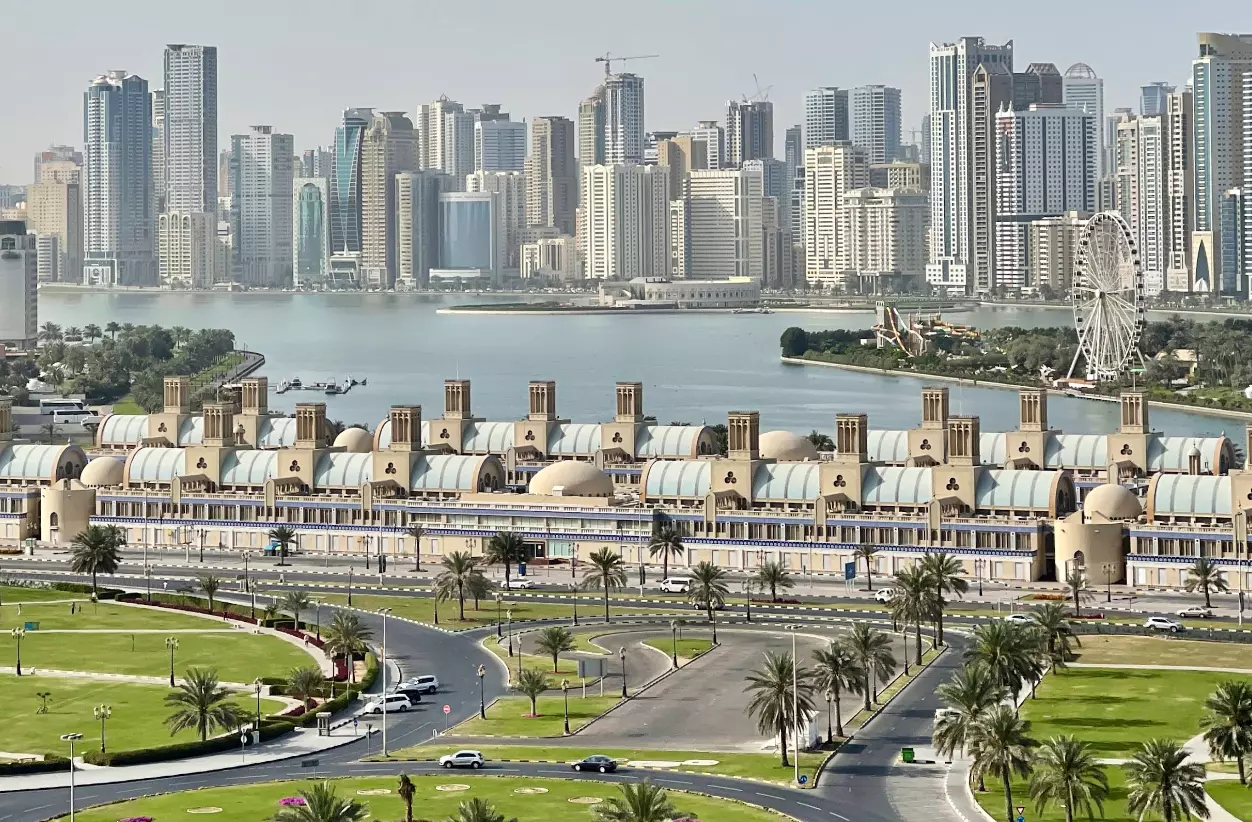
Also known as the Central Market, the Blue Souk is Sharjah's most recognizable landmark in terms of architecture, a traditional-style market designed in the 1970s by British architects and inaugurated in 1978.
The complex consists of two interconnected buildings housing roughly 600 shops offering everything from souvenirs and local textiles to jewelry and boutique goods. It is a short distance from Sharjah Corniche and sits within the historic waterfront area.
Zero Six Mall blends fine dining, leisure, shopping, and well-being in a format that attracts both residents and visitors.
It features well-known international brands including H&M and Foot Locker, a multi-screen cinema, and an array of restaurants and cafés. Located near the Muwaileh Commercial Sharjah district, it serves residents in the Muwaileh, University City, and Tilal City corridors.
Mega Mall was opened in 2001 and houses over 150 retail outlets across four floors. It has Novo Cinema screens and an Antic's Land family entertainment center.
It continues to draw steady footfall and is practical for residents in the central and Al Majaz Sharjah districts. On the other hand, Ansar Mall has a seven-storey shopping mall on Al Ittihad Street.
Ansar Mall in Al Nahda Sharjah, is a budget-friendly option offering a broad range of retail at accessible price points.
It serves the dense residential population of Al Nahda, a neighbourhood where affordability and proximity are more important than prestige.
Safari Mall Sharjah, located in Muweilah on Sheikh Khalifa Bin Zayed Al Nahyan Road, positions itself as an all-around destination for shopping, dining, VR gaming, and general leisure.
It is a community-oriented mall, which means it is generally quieter than the larger destinations and more suited to everyday errands than special-occasion shopping.
Beyond the malls, Sharjah is well-served by supermarket chains including Carrefour, LuLu Hypermarket, West Zone Fresh, and several independent grocers, particularly in Abu Shagara Sharjah, Al Majaz 1 Sharjah, and Al Qasimia Sharjah.
Pharmacies are distributed throughout all residential communities, with Thumbay Pharmacy operating a chain of neighbourhood pharmacies across the emirate, including in the Abu Shagara and Al Nahda Sharjah zones.

Sharjah's restaurant scene covers a meaningful range, from Emirati and Levantine cuisine to South Asian, East Asian, and international options, though the strict no-alcohol policy across all public and private venues makes the dining culture in a fundamental way.
The result is a distinctly family-oriented, community-centred dining environment, which many residents specifically seek out. And waterfront dining carries a particularly strong appeal here.
The most atmospheric dining corridors in the emirate are along the Sharjah Corniche, the Al Majaz Waterfront near Al Majaz 1 Sharjah, and the seafront areas of Al Khan and Maryam Island.
These promenades have a combination of standalone restaurants, hotel dining outlets, and casual cafés, and they tend to come alive in the cooler evening hours, especially between October and April.
Hotel restaurants within properties like The Chedi Al Bait offer more refined dining experiences, including Emirati cuisine, international buffets, and private dining setups. The Sheraton and Pullman also operate well-regarded in-house restaurants.
Beyond the hotels, community dining in Abu Shagara, Sharjah Al Majaz, and the areas surrounding Sahara Mall, Sharjah includes a wide variety of South Asian, Arabic, Filipino, and Southeast Asian restaurants, reflecting the demographic mix of those residential zones.
The Chedi Al Bait sits in the Heritage Area of Sharjah, housed in a collection of repurposed heritage homes that have been carefully preserved to retain their architectural character.
The property has its own museum, library, cigar lounge, and jewelry boutique, which gives it a depth that most standard luxury hotels don't have.
There are 53 elegant bedrooms decorated in a contemporary Arabic meets Asian design, and two restaurants covering international and gourmet family-style dining.
Coral Beach Resort Sharjah is a beachfront property with a resort-style setup, offering a pool, beach access, and multiple dining options. It serves both leisure travelers and longer-stay residents from communities on the Sharjah Beach side of the emirate.
Sharjah Palace Hotel combines traditional Arabian architecture with modern amenities, including a spa, fitness center, and outdoor pool. It is situated in the heart of Sharjah and serves as a practical mid-to-luxury option for guests who want to be centrally located near the heritage and cultural districts.
These two properties serve the mid-range and extended-stay markets, relevant to professionals working across both the Sharjah industrial zones, including Industrial Area 6, Sharjah, and the Dubai border corridor. These are practical rather than aspirational stays, but they are well reviewed for what they offer.
Note: Estimates based on normal traffic. Peak hours may add 10 - 20 minutes on major routes.
Roads & Intercity Buses
Sharjah is well connected to Dubai through major roads such as Sheikh Mohammed Bin Zayed Road (E311), Emirates Road (E611), and Al Ittihad Road (E11). Regular intercity buses operate between Sharjah and key destinations in Dubai, making daily commuting convenient.
Popular routes include E303 (Union Square–Al Jubail), E306 (Al Ghubaiba–Al Jubail), E307 (Deira City Centre–Al Jubail), E307A (Abu Hail–Al Jubail), and E315 (Etisalat Metro–Muwailah).
Many Sharjah residents use Dubai Metro stations for their daily commute into Dubai. The most commonly used is Stadium Metro Station on the Green Line, which connects directly to the intercity bus route E308.
Etisalat Metro Station, also on the Green Line, offers an intercity bus link and features a park-and-ride facility accommodating over 2,300 vehicles.
Centrepoint Metro Station in Rashidiya, on the Red Line, is also frequently used by residents from Al Nahda Sharjah, and Muwaileh who prefer direct Red Line access into central Dubai without interchanging lines.
Both Uber and Careem operate within Sharjah and across the border into Dubai. A surcharge of AED 20 applies when crossing emirate boundaries by taxi, something to factor in for daily commuters.
Sharjah International Airport (SHJ) is the emirate's own air hub, serving as a base for Air Arabia and a number of regional low-cost carriers. It provides direct connectivity to South Asia, East Africa, and destinations across the Middle East, which is relevant for residents with family ties to those regions.
Sharjah's outdoor offering is broader than people initially assume. The emirate stretches from desert to two coastlines, and a meaningful range of outdoor experiences is genuinely accessible.
Sharjah Corniche is a continuous promenade running along the western seafront near Al Majaz Sharjah and the Buhaira area. It is used daily by residents for jogging, cycling, and walking, particularly in the cooler months between October and April.
The promenade passes through several community zones, connecting Al Majaz 1 Sharjah, to the central waterfront area.
Adjacent to Al Majaz Sharjah, the Al Majaz Waterfront is the emirate's most prominent outdoor leisure destination, sitting along the Khalid Lagoon. It features a musical fountain, jogging tracks, children's play areas, and outdoor dining. The adjacent Buhaira Corniche extends this outdoor corridor further into the city.
Sharjah Beach is a public beach along the Arabian Gulf, free to access and regularly maintained. It is used for swimming, beach sports, and watercraft activities. So is Al Khan Beach, which borders the Al Mamzar coastal zone shared with Dubai on its southern edge.
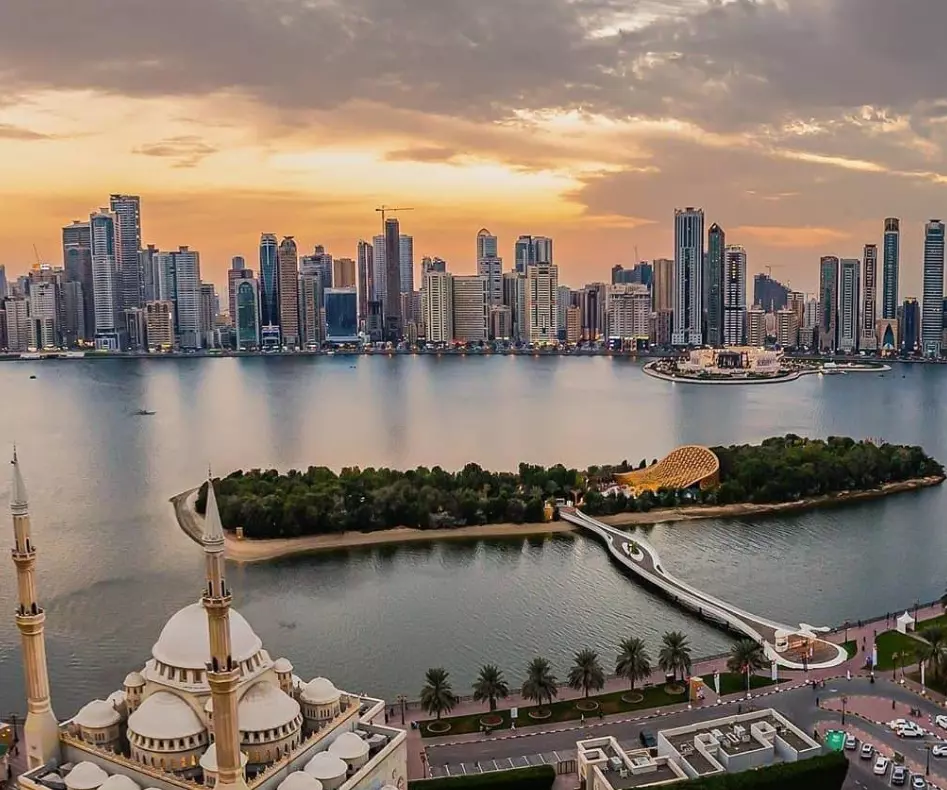
A landscaped island near the Corniche in the Al Khan area, featuring a butterfly house, sculpture garden, and illuminated night walkways. Primarily a pedestrian experience, best visited in the evening. It is close to Al Majaz 1, Sharjah, and within easy reach of the central cultural district.

Located near the Al Khan waterfront and bordering the Al Mamzar coastal zone, Al Montazah includes Adventureland and Aquapark, primarily aimed at families with children. It draws visitors from communities across both the Sharjah and Dubai sides of the border.
Sharjah National Park is a large green expanse near Tilal City and the Masaar community. It offers open parkland for walking, cycling, and picnicking, and it borders some of the newer residential developments in the Suyoh district.
Al Mahatta Park Sharjah is a public park in the central city area, offering walkways, greenery, water features, a children's play area, boat riding, and a small mosque on site. It is a well-used local park rather than a destination attraction, the kind of place residents use regularly.
In Sharjah's desert interior, Fossil Rock is a geological and archaeological site popular for hiking, off-road driving, and fossil spotting. It is accessible within approximately one hour from central Sharjah and represents a genuinely unusual outdoor experience for residents willing to explore beyond the urban areas.
Sharjah's fitness is defined by its character as a family-oriented, academic city. University City drives sports programs and indoor facilities for students. Parks and waterfront promenades, Sharjah Corniche, and Al Majaz 1 Sharjah function as outdoor gyms and are heavily used in the early morning and evening hours.
Pricing is generally lower from Dubai and Abu Dhabi, but with maintained quality. And monthly memberships are from AED 150 to AED 400, depending on the facility and membership type.
Fitness First has several branches across Sharjah with a wide variety of weight and cardio equipment, group exercise classes, and, at some locations, swimming pools. It is one of the more established international chains operating in the emirate and covers communities including Al Majaz Sharjah, Al Qasimia Sharjah, and the areas around Sahara Mall Sharjah.
GymNation operates multiple branches in Sharjah, including dedicated ladies-only facilities in Al Zahia and Mega Mall. The brand is known for accessible pricing and a no-frills but well-equipped model. The ladies-only branches reflect a genuine demand in the emirate; segregated training options and women-only studios are both common and popular.
A well-regarded community gym with a friendly environment, a varied class schedule, and skilled trainers. Positioned for residents who prefer a neighborhood gym with a consistent clientele rather than a large commercial facility.
Beyond the gyms, Sharjah holds occasional fitness events and community challenges. Residents use the parks, waterfront promenades, and green corridors of communities like Aljada, Al Zahia, and Masaar for outdoor running, cycling, and group classes. Yoga sessions and group boot camps are a regular fixture along Sharjah Corniche and Al Majaz 1 Sharjah in the cooler months.
Community Bound & Lifestyle
Sharjah holds the formal designation of UNESCO World Book Capital and is consistently recognized as the Cultural Capital of the Arab World. This is visible in how the emirate is physically laid out.
The Sharjah Art Foundation operates year-round programming, including the Sharjah Biennial, one of the more significant contemporary art events in the Arab world.
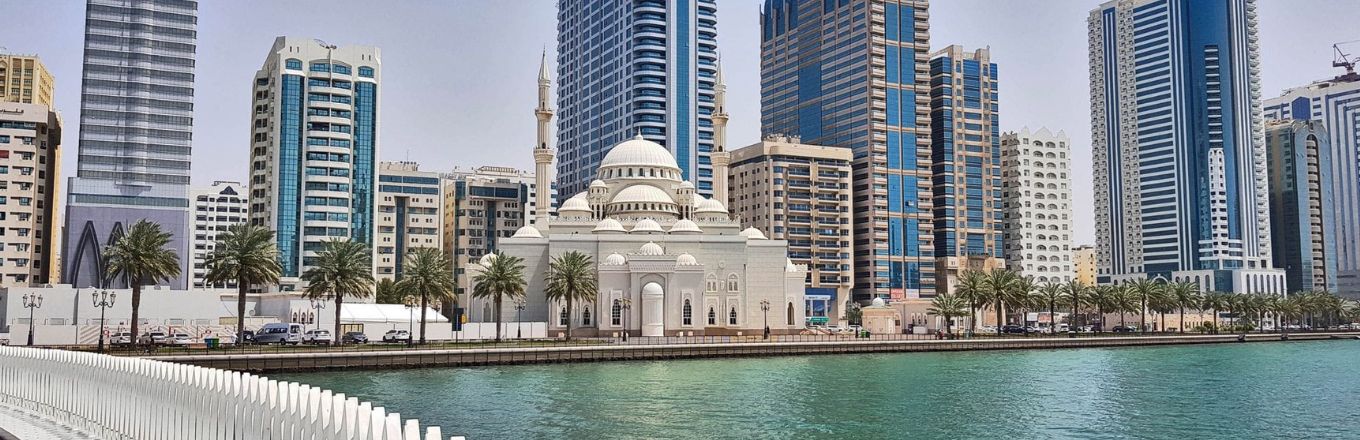
The Museum of Islamic Civilization, the Heritage Area, Al Noor Island, and the Sharjah Grand Mosque are permanent cultural anchors that give the city a depth of character distinct from neighbouring Dubai.
Sharjah has many mosques in all neighborhoods, including the large Sharjah Grand Mosque near the city center. The smaller mosques are easily found in residential areas, making daily prayers easy for residents.
Sharjah is genuinely affordable compared to Dubai, and that gap is still real in 2025. Rental yields between 6% and 9% are hard to ignore. Families tend to appreciate the no-alcohol policy, the school density near Muwaileh, and the quieter pace. The biggest edge is living close to Dubai while spending considerably less.
The Dubai commute is the thing most residents mention first. Traffic on Al Ittihad Road can be exhausting daily. Sharjah's no-alcohol policy limits dining and nightlife options significantly. And although ownership laws have improved, foreign buyers still face more restrictions here than in Dubai or Ras Al Khaimah.
Can foreigners buy property in Sharjah without UAE residency?
Yes. From 2022, foreign nationals can own real estate property. But only in designated freehold zones without holding residency in the UAE. Usufruct rights of up to 100 years are also available. No residency requirement applies at the point of purchase.
What are the most family-friendly communities to live in?
Al Zahia, Muwaileh, and Aljada are the first choice by families consistently, as they have schools, parks, and community services within an understandable distance. Muwaileh in particular sits close to University City, making it practical for families with children across multiple school ages.
How difficult is the daily commute between Sharjah and Dubai?
Peak hours on Al Ittihad Road and Sheikh Mohammed Bin Zayed Road can add significant time. Many use park-and-ride options near Dubai Metro's Green Line stations, which makes it more manageable and considerably less expensive than daily taxis.
Unlock an Exclusive Deal!

New Units for Sale Coming Soon
Find your dream property for Sale with expert guidance and personalized support
Consultation with Our Expert
We will call you back within an hour and also send you additional information by emailUnlock an Exclusive Deal